
In an article recently published in the Friends Quarterly magazine, one Bath Quaker sets out her thoughts on diet, agriculture and the environment. More details of Ali Morgan’s research and her book can be seen at https://www.whyveganshavesmallerbrains.com/
Are we eating Quakerly?
Ali Morgan
There is growing pressure on Quakers to adopt plant-based diets. These are increasingly promoted to young and old, as the ethical, even Quakerly lifestyle. For example, the Friends House Seed café states that it is ‘proudly 100% vegan and vegetarian’, offering ‘ethical’ and ‘nutritious’ options for all’, and that ‘by choosing vegan or vegetarian dishes you’re making a positive impact on your health and the planet’ [1]. This is very forceful messaging for a faith body that claims to have no creed or dogma, and which claims to be committed to inclusivity[2]. To begin with, meat-eaters are excluded, from the options. The message is, that meat eating, is unethical, unQuakerly. Are these messages true?
If you are vegan or vegetarian, please hear me out. I respect that you believe your choices are ethical and better for the environment, better for animals and healthier for humans. I share your good intentions, but going plant-based will not achieve them. This essay explains why it is not sustainable, healthy, or ethical to advocate plant-based diets. Since we all have to eat, and most foods come from farming, my main aim here is to provide a better understanding of how different farming systems impact our planet and the other creatures we share it with. I will also explain the reasons why crop farming (especially without livestock) is so harmful, whereas livestock farming can be positively beneficial.
As a farming and environment specialist for over 40 years, I have worked with arable (crop) farmers and livestock farmers across Britain, and overseas, including conventional, organic and regenerative farming. The impacts of farming and food systems on the environment and animals have been my lifelong concern, as well as my professional expertise. I believe these things are so important, and so misunderstood, that I wrote a book about it, co-authored with a doctor and a geophysicist.[3]
My childhood passion for animals and nature led me first to study Zoology at university. But realising that most nature in Britain exists within the farmed environment, and that is where nature is most threatened, I switched to a degree in Agriculture, despite having no farming background. Following university, I trained as a farm adviser, beginning work in the 1980s, when government farming policy was just beginning to transition from postwar intensive production to greater environmental awareness. Soon, work took me from my native southwest, to the east of England – Britain’s most arable (crop farming) region, where most of our wheat, sugar, potatoes, vegetables and oilseeds are grown. It was these years in the arable east, and my lack of farming background, that made me begin questioning the way we were farming; questioning in a way that my farming-born-and-bred colleagues rarely did.
Today, just 2-3% of British people work in farming or the farmed environment. The number is similar in most other industrialised countries. Most of us have little understanding of how farming systems impact the environment or animals. Our beliefs are mostly influenced by repeated media and lobby group messaging, or peer group pressure. But these sources often tell simplistic stories, whilst biological and farming systems are complex, with many intertwined cycles and inter-dependencies.
The vegan ideal is a world with no livestock farming and all humans living entirely on plant foods – food produced by arable farming. Most people, when asked, say they believe organic or regenerative farming is best and most sustainable. And I would agree. However, the essential foundation of organic and regenerative farming is livestock farming – its manure and its pasture. But a vegan world has no livestock! Crop farming, disconnected from livestock farming, is extremely damaging. What mitigates the harms of arable farming is livestock farming, especially pasture-reared grazing animals like beef cows.
I do not claim that all livestock farming is good. I do not eat or advocate intensively reared animal products – not just for animal welfare or pollution reasons, but because intensive livestock farming depends on feeding grains. It is the growing of grains and other crops that causes so much environmental harm, whether grown for animals or humans.
What about vegetarianism? For human health, it is essential to include animal foods in the diet, but vegetarian diets rely on eggs and dairy; two of the most intensively farmed animal foods. By contrast, beef cattle and sheep farming are the most extensive, low input of farming systems in the UK, with the least animal welfare and environmental harms. Pasture-rearing of cows and sheep can be positively beneficial to the environment and animal life, as well as to human health.
Climate: The answer lies in the soil
If we look back a hundred years or so, what kind of crop farming would we have seen? For millennia farmers grew arable crops in rotation with livestock, especially grazing cattle and sheep: one year of wheat, followed by grass and livestock. Why? After all, if land is good enough to grow arable crops why not grow them continuously, as most arable farmers do today, and graze animals on other land that cannot be cropped (what we call marginal land)? Because diesel-fueled machinery and agrochemicals (themselves manufactured with high fossil fuel emissions) were not widely available then. Only in the last century, since diesel, artificial fertilizers and pesticides arrived, could arable farmers dispense with livestock and begin growing crops continuously. By the 1980s when I moved to East Anglia, artificial fertilizers had almost entirely replaced livestock manure to feed the crop monocultures; and endless pesticide spraying had replaced the grass that used to break the buildup of weeds, pests and crop diseases. Meanwhile, arable farmers had ripped out thousands of miles of wildlife-rich hedges that had previously provided boundaries for livestock.
Tragically today, 98% of crop farming in the UK is highly intensive and completely reliant on fossil fuels and agrochemicals. It produces far higher greenhouse gas emissions (GHGs) than grazing livestock, and is destroying biodiversity and the soil itself. Three quarters of the topsoil in East Anglia has already been lost. The story is similar across the industrialised world.
Cropping without livestock degrades soil. Soil is the foundation of all life on Earth. In simple terms soil fertility is carbon and microorganisms. The soil is the Earth’s largest terrestrial carbon store, and it holds more than half of the Earth’s life. Grassland soils hold much more carbon and biodiverse life than arable soils. In fact, temperate grasslands store more carbon than temperate forests, and they store it more safely, below ground, away from wildfires. These carbon-rich grasslands cover two thirds of the farmed land in Britain and worldwide. It is vital that we protect them, both to mitigate climate change and protect the biodiversity they support.
When pasture is converted to arable cropping there is massive loss of carbon from the soil to the atmosphere as carbon dioxide (CO2). Most of it is lost in the first year or two after conversion. If we switch arable land back to pasture, the carbon moves the other way from atmosphere to soil, benefiting the soil and the climate. To suggest that we should remove grazing livestock and replace pastures with more arable crops, or even with trees, is environmental vandalism. Listen to soil scientist, Professor Andy Neal says, for instance. https://www.youtube.com/watch?v=mSlHiNmn3Ls
Arable crops are annual plants that have to be resown every year after harvest. This means tilling the soil every year, exposing the soil carbon to the air, which oxidizes it to CO2. We have lost 15-20% of the Earth’s soil carbon since people began crop farming. Much of the atmospheric CO2 increase has come from soil in this way. Even after an arable crop is sown, a lot of soil remains exposed for much of the year. We now advise farmers to sow cover crops and use minimal tillage, but this does not completely eliminate carbon loss or soil erosion. In addition, arable plants do not sequester (draw down) carbon from atmospheric CO2 into the soil, as pasture does.
Pasture plants are perennials, growing continuously without reseeding. They densely cover the soil surface all year round and don’t need to be tilled. They protect the soil carbon, whilst their dense root systems create soil structure, drainage and aeration, encouraging soil life. The roots exude carbon-rich sugars (made from atmospheric CO2), supporting soil organisms and building soil carbon stores. Fungal mycelia, undisturbed by tillage, help to transfer and incorporate the plant sugars into the soil. The cow plays her part, adding carbon-rich dung to the soil, and her grazing stimulates the plant roots to exude sugars. The cow dung supports dung beetles and other organisms that incorporate it into the soil. They in turn provide food for bats, birds and other wildlife, while the dung comes pre-inoculated with microbes that contribute to the soil microbiome.
Cow burps and flux gases
All ruminants burp out methane, both livestock and wild species. But ruminant methane does not add methane or carbon to the atmosphere, because it is part of the biogenic (fast) carbon cycle [4] [5]. In fact, pasture-reared cattle help to draw down carbon from the atmosphere and store it beneficially in the soil (carbon sequestration). Consider humans: Like all animals we breathe out CO2, but the IPCC[6] does not count this as a greenhouse gas (GHG). It is just a flux gas that cycles in and out of the atmosphere. Plants draw down CO2 from the atmosphere and use this carbon to make sugars and other carbohydrates to grow roots, stems and leaves. We eat the plants or we eat the animals that eat the plants, and CO2 is a byproduct of our food metabolism. It just replaces the atmospheric CO2 that the plants extracted. This is very different from the slow carbon cycle that takes billions of years to form fossil fuels. Ruminant methane (CH4) is also a flux gas. This methane carbon also comes from CO2 drawn down by the plants that the cow ate. The methane rapidly breaks back down to carbon dioxide in the atmosphere, and this replaces just some of the CO2 that the plants removed. Some of the carbon is diverted into the soil (carbon sequestration) via the cow dung and the sugars that the grass roots exude. So pasture and grazing livestock like cows and sheep contribute to a net reduction in atmospheric carbon.
The Biogenic (fast) Carbon Cycle
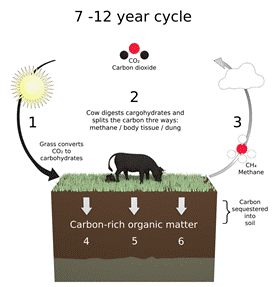
Beef and sheep farming are the least intensive of all farming systems. They use far less diesel and artificial fertilizers than crop farming, almost no pesticides or soya[7], and they feed less grain than any livestock system.
I mentioned that two thirds of our farmland is marginal land that cannot grow crops. This is where most of our beef and lamb is reared, so they do not misuse land that should grow crops for humans. As described earlier, for the sake of our soils, our wildlife and GHG emissions, we would be wise to revert to grazing cattle and sheep in arable rotations too.
Perhaps you think it would be better to rewild or reforest these marginal lands and remove the livestock. But the ruminant meat we rear from these areas provides very important additional food. Unlike plant foods, meat is nutrient dense. Eliminating livestock from marginal areas would mean intensifying farming elsewhere to replace the lost nutrition, or importing more food from abroad. Since plant foods lack essential nutrients, they cannot replace this meat. The only other alternative is to increase intensive livestock production, with its associated downsides.
Not only do pasture-reared livestock provide important foods for us, they can be extremely beneficial to the environment. They not only contribute to carbon sequestration, thereby mitigating GHG emissions; their grazing also creates biodiverse habitat, encouraging insects, birds and other wildlife.
Animal death and suffering
Eating beef obviously involves killing animals. In Britain this is done humanely, under veterinary supervision. However, plant-based diets necessitate the killing of 20-25 times more animals, per kilo of protein produced. Every year crop farmers in Britain and all over the world, shoot, trap and poison billions of birds, rabbits, hares, deer, rodents and other wild animals, to stop them eating the crops. These are wild animals, many of them declining in numbers. On top of this, arable cropping involves almost complete eradication of habitat. Wildlife populations have plunged in recent decades, as a result. By contrast, large herbivores are beneficial and important habitat creators. Cattle, sheep and goats are often introduced deliberately, to support habitat and biodiverse wildlife. Even the case of the badger has been widely misrepresented. Despite the notorious badger cull in the southwest of England, cattle farming has never threatened badger populations, in fact quite the opposite. Badgers have thrived and multiplied in the southwest precisely because of the habitat and rich food sources created by cattle pasture and hedgerows. It is in the east of England that badgers, hedgehogs and other wildlife populations have declined, because of the habitat destruction and pesticides involved in arable farming.
Insect populations have declined by 80% in the last 30 years, according to international studies. Earthworms and other soil organism populations have also crashed. This is nothing short of catastrophic. These tiny lives provide the foundations of ecosystems worldwide. The main cause is arable farming – the tillage, agrochemical use and habitat destruction. In Britain, 99% of all pesticides are used on arable crops; only 1% in livestock farming. Over 98% of UK arable land is sprayed with pesticides multiple times each year. The average wheat crop is sprayed seven times per season with around 20 different active ingredients (poisons), combined in cocktails of insecticides, molluscicides, herbicides, and fungicides. Potato crops average 31 active ingredients per season. These different components interact to cause even more death and destruction. Insecticide use on UK croplands kills an estimated 390 trillion insects each year, whilst it is 3.5 quadrillion on US cropland. In California (from where the UK imports most of its almonds), almond farming kills 50 billion honeybees each year, not to mention the other, wild insects.
Our health
Over the last 50 years, US, UK and other populations have significantly reduced consumption of animal fats and meat, based on dietary advice and research that is now recognised to be highly flawed [8] [9]. Those animal foods have been replaced by very high consumption of carbohydrates and vegetable oils. The results have been soaring rates of obesity, diabetes, cardiovascular disease, Alzheimer’s disease and auto-immune diseases. We are also seeing unprecedented levels of mental illness among younger adults and children.[10] The work of Professor Thomas Seyfried[11] and others show that many cancers are metabolic diseases driven by high carbohydrate diets. Our ‘Eatwell’ dietary guidelines, based on the US food pyramid, are upside down! As explained in our book [12] there is extensive evidence that the healthiest human diet is the one we evolved on, a ketogenic (high fat – low carbohydrate) diet – ideally, based on fatty meat.
We humans are the only species on Earth that has abandoned our evolutionary diet, except for our pet dogs and cats, large numbers of whom now suffer from the same diseases as us, for the same reason. Dogs and cats, like us, are carnivores, but we feed them and ourselves with carbohydrates and other plant foods that their ancestors and ours did not eat during our evolution.
Humans began crop farming just 10-12,000 years ago, and human health declined sharply following this, with brain shrinkage, poorer bone and dental health and metabolic disease. For 300,000 years before that, our species, Homo sapiens, was almost entirely carnivorous, hunting and eating large, fatty herbivores. Before us, there had been 6 million years of hominin evolution, during which our brain size tripled, driven by eating nutrient-dense, fatty meat and organs meats. Crucially, our human gut also evolved very differently from those of chimpanzees and other apes (whose brains have not grown in 6 million years). They adapted to eating fibrous plants, whereas we adapted to animal foods.
Pre-agricultural plants were largely inedible for Homo sapiens, because they were so fibrous and contained so many anti-nutrients, such as gluten, lectins, phytic acid, trypsin, tannin alkaloids and protease inhibitors, that interfere with the absorption of nutrients. 10,000 years of plant breeding made agricultural plants more edible, but most plant foods still contain anti-nutrients that damage our gut and contribute to auto-immune diseases. [13] Grains and legumes are among the most harmful. Vegetable oils are inflammatory, contributing to disease. Yet vegan and vegetarian diets are heavily dependent on grains, legumes and vegetable oils. The primary purpose of plant breeding has been to increase calorie yield, but humans need nutrients not just calories, and plant foods are deficient or devoid of many essential nutrients.
Plants are especially poor sources of vitamins and fatty acids. Vitamin B12 and DHA[14] are just two of the many nutrients completely absent from plant foods. Both are essential for human brain health and development. Studies in pregnant and breast feeding women show that the absence of animal foods from the mother’s diet causes brain atrophy (shrinkage) in their babies, owing to these deficiencies [15][16] [17] [18] [19]. In adults, these deficiencies speed up the rate of brain atrophy, contributing to poor mental health and dementia [20] [21]. Meanwhile, high carbohydrate foods like sugar, bread, pasta, rice and other grains, and starchy vegetables are driving insulin resistance, obesity, diabetes, cardiovascular disease and more.
So, what is the way forward? To continue pushing plant-based diets that are making us mentally and physically sick? To keep ploughing up carbon-rich pastures to grow more fossil fuel and agrochemical dependent crops? Keep turning our land into carbon dioxide-emitting deserts, devoid of insects and other wildlife until all our ecosystems collapse? Where will we grow crops when all the soil is gone?
In the UK, we currently devote 72% of our arable land to growing cereals (for humans and livestock feed), 10.2% and rising to sugar beet, 7.7% to oilseeds, and 2.8% for potato growing. Nearly 93% of our cropland is being wasted to grow foods that are making us fat and sick, and which contribute little nutrient value to our diet except calories. Many people in this country are malnourished, whilst also being overweight. Only 3.4% of our land is being used to grow fruit and vegetables, whilst we import two thirds of these, often from water vulnerable, climate vulnerable, food insecure countries, and with huge rates of wastage and emissions. What if we reduced this wasteful carbohydrate and oilseed acreage? We could grow all the fruit and vegetables you might want (though not necessarily the same kinds). And we could switch arable land to grass, in rotations and permanent pasture, to rear more meat (and dairy) regeneratively. Not only would this benefit the environment, but it would also hugely benefit the health of our nation.
Of course, there are situations where livestock farming is doing harm currently, especially intensive, grain based livestock. And there is room for improved management in some grazing situations too. But the point is that we can improve grazing livestock farming. We know regenerative grazing is positively beneficial to soil, climate and wildlife. There is a growing community of regenerative pasture farmers and organisations like Pasture for Life, Groundswell and the Oxford Real Farming Conference. But the only ways to reduce the soil damage, emissions and agrochemical destruction being wreaked by arable farming is to do less of it, and add pasture-reared livestock back into arable rotations.
So, what is an ethical, Quakerly diet? If by this we mean one that will help to reverse climate change, protect the soil, restore biodiversity, reduce animal death and suffering, and give us long, healthy lives whilst reducing NHS costs, then we need to eat a ketogenic (high fat – low carbohydrate) diet based on pasture-reared meat.
Note: For a full understanding of the issues outlined in the essay above, please see:
Ellis D, Morgan A, Tagore A. Why Vegans Have Smaller Brains And How Cows Reverse Climate Change. Wild Cat; 2024. The full list of references and information sources for this book can be found under the reference section at www.whyveganshavesmallerbrains.com
[1] Seed Cafe 100% vegan and vegetarian café in Euston – Friends House
[2] Equality, Diversity & Inclusion in our venue | Friends House
[3] Ellis D, Morgan A, Tagore A. Why Vegans Have Smaller Brains And How Cows Reverse Climate Change. Wild Cat; 2024
[4] Ellis D, Morgan A, Tagore A. Why Vegans Have Smaller Brains And How Cows Reverse Climate Change. Wild Cat; 2024, Chapter 18, pp 233-238.
[5] Mitloehner F. Why methane from cattle warms the climate differently than CO2 from fossil fuels. CLEAR Center. 2020. Available from: https://clear.ucdavis.edu/explainers/why-methane-cattle-warms-climate-differently-co2-fossil-fuels
[6] Intergovernmental Panel on Climate Change
[7] Most soya is imported to Britain from Latin America where its production contributes to deforestation. The largest portion (45%) of these imports are used to make plant-based dairy and meat alternatives.
[8] Ellis D, Morgan A, Tagore A. Why Vegans Have Smaller Brains And How Cows Reverse Climate Change. Wild Cat; 2024,
[9] Teicholz N. A short history of saturated fat: the making and unmaking of a scientific consensus. Current Opinion in Endocrinology, Diabetes & Obesity. 2022 Dec 8;30(1):65–71.
[10] Ede G. Change Your Diet, Change Your Mind. Yellow Kite; 2024
[11] Seyfried T. Cancer as a Metabolic Disease. John Wiley & Sons; 2012
[12] Ellis D, Morgan A, Tagore A. Why Vegans Have Smaller Brains And How Cows Reverse Climate Change. Wild Cat; 2024,
[13] Ellis D, Morgan A, Tagore A. Why Vegans Have Smaller Brains And How Cows Reverse Climate Change. Wild Cat; 2024, Chapter 13
[14] Docosahexaenoic Acid, an omega-3 fatty acid vital for brain and eye health
[15] Ellis D, Morgan A, Tagore A. Why Vegans Have Smaller Brains And How Cows Reverse Climate Change. Wild Cat; 2024, Chapter 9
[16] Kadiyala, A., et al., Prevalence of vitamin B12 deficiency among exclusively breast fed term infants in South India. Journal of Tropical Pediatrics, 2021. 67(1): p. fmaa114.
[17] Lövblad, K.-O., et al., Retardation of myelination due to dietary vitamin B 12 deficiency: cranial MRI findings. Pediatric radiology, 1997. 27(2): p. 155-158.
[18] Ozyurek, H., et al., Vitamin B12 deficiency as a treatable cause of severe brain atrophy. Neurology Asia, 2021. 26(1).
[19] Rashid, S., V. Meier, and H. Patrick, Review of Vitamin B12 deficiency in pregnancy: a diagnosis not to miss as veganism and vegetarianism become more prevalent. European Journal of Haematology, 2021. 106(4): p. 450-455.
[20] Gilsing, A.M., et al., Serum concentrations of vitamin B12 and folate in British male omnivores, vegetarians and vegans: results from a cross-sectional analysis of the EPIC-Oxford cohort study. European journal of clinical nutrition, 2010. 64(9): p. 933.
[21] Zhang, Y.-P., et al., Effects of DHA Supplementation on hippocampal volume and cognitive function in older adults with mild cognitive impairment: a 12-month randomized, double-blind, placebo-controlled trial. Journal of Alzheimer’s Disease, 2017. 55(2): p. 497-507.
Vogiatzoglou, A., et al., Vitamin B12 status and rate of brain volume loss in community-dwelling elderly. Neurology, 2008. 71(11): p. 826-832.
 Bath Quakers